Tuesday, October 27, 2015

Sermon for All-Hallows 2015

Preached at St. John's Lutheran Church, New Freedom on October 25, 2015
Scripture Texts: Ezekiel 37:1-14


The ancients said of this day that the barrier between this world and the next grew thin and allowed the dead to walk among us. Traditions grew up around that myth and folklore, traditions that the Church later adopted when it made these days the celebration of All-Saints and All-Hallows. We don these costumes as mockery of those ghosts and spirits. What have we to fear of them? The lot of us are a lot scarier than they are. Or so we’d like to think.

But let’s be honest. Death is scary. It’s one thing we all face in life that there is no overcoming on our own. We can dodge it, avoid it for a time, but eventually it comes for all of us. What is it? What is it like to die? What’s on the other side, if anything? None of us really knows. Those are questions we don’t have answers to and they are questions we won’t have answers to until that moment it comes for us. Death is the true unknown and the truly unknowable.

But there is one thing we do know about it. We know that it hurts. Not necessarily for us when we experience it ourselves, but it hurts for those who are left behind. Those who grieve. Those who mourn. Many of us have had to say good-bye already to beloved grandparents or friends or someone else who mattered to us and if we haven’t yet, we will. The questions about what happens to us echo in our curiosity about their fate. What becomes of those who matter most to us when they die? Will we see them again? Will we be reunited? Again, those are questions to which we have no solid answers.

What we have instead is faith. Faith in a God who tells us time and again that death is his problem to solve and that he will take care of it. Faith in a God who says that we will be with him in eternity. Faith in a God who has sent his son into our world to live, to die on a cross, and to rise again on the third day. Faith in a God who has claimed each of us as his own through our baptism.

Just a few minutes ago, we heard the song Tourniquet by Evanescence. It’s a song that asks many questions, many of these same questions that we’ve heard in this sermon. Will God be there for us? Or is death really the end? Amy Lee’s lyrics sound like a fanciful paraphrase of Ezekiel. “Our bones are dried up, and our hope is lost; we are cut off completely.”


God’s answer to that is to bring bone together with bone and to breathe life where there is death. “Thus says the Lord God: I am going to open your graves, and bring you up from your graves, O my people...I will put my spirit within you, and you shall live.” That is his promise to us. That is what Jesus was about. That’s why he came. It’s why he died. And it’s why he rose again.

That’s what tonight is about. The light still shines in the darkness and the darkness has not overcome it.

At its core, that is what Halloween is about. This day is a remembrance of the dead, a remembrance that death is real. Much like Ash Wednesday, we are reminded that we are dust and to dust we shall return. And yet, we also remember in the midst of that reality that Christ has conquered death through his own death and resurrection. That life is stronger than death and life is what we are promised in the end. Eternal life. Life with God.

That is our faith. That is what we believe. It is why we are here on this night and every time we gather in worship. We gather to remember the promises, to celebrate what God has done for our sake. To remember that there will come a time when he will bring us home to be with him forever. Amen.


Sermon for Reformation Day 2015

Preached at Canadochly Lutheran Church on October 25, 2015
Scripture texts: None

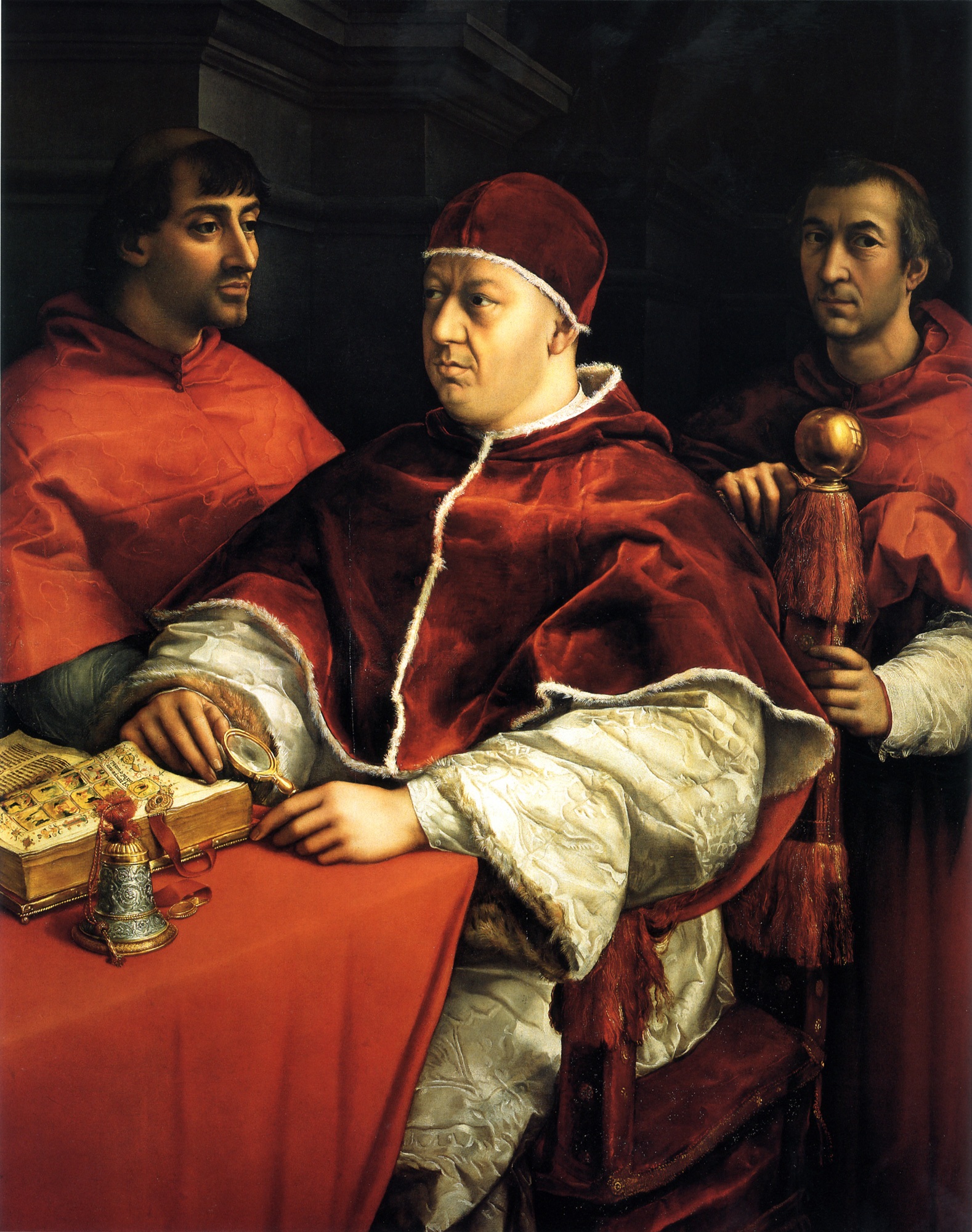
Image from Wikipedia

Who am I? You would dare question! We are Leo, the tenth of that name. The Vicar of Christ, the Pope of Holy Mother Church. We came to sit the throne of St. Peter in the year of our Lord 1513. Before that, we were Giovanni de Medici, scion of the powerful and wealthy Medici family of Florence.

Who am I indeed! What a foolish question. I received my cardinal’s hat when I merely a boy of 14, studying for the priesthood. I ran with the likes of Cesare Borgia and Alessandro Farnese, the royal sons of Rome in those years. Hellions all, we tore up and down every tavern and brothel in the city.

Of course, those wild years were cut short when Savonarola arose in Florence. That iconoclastic monster! Drove my family from power. Burned priceless books and paintings in his “bonfire of the vanities.” Claimed God was going to bring down his judgment on his wayward Church. The fool! He dared to stand up to the Vicar of Christ. Dared to challenge the Pope! He burned for his folly.

But childhood came to an end. My brothers and I had to pick up the pieces of our beloved city after Savonarola’s barbarism. By the time I was elected to the papacy, I was well-prepared to sit the throne of St. Peter. After all those hard years, I was determined to enjoy it.

And then...then came Luther. That wild boar of Germany. Another fool in the mold of Savonarola and clearly one who had not learned the lesson of that episode. That heretic, that drunken little German monk who had audacity to defy me!

It began with St. Peter’s, the grand basilica of Rome. Like my predecessors before me, we sought to rebuild the grand cathedral of Holy Mother Church, to make of it a temple to rival Solomon’s in its glory. But to do that, we needed money. My predecessors lived in difficult times. Wars consumed the Papal treasury as my fellow Pontiffs supported France against Spain, England against France, Italy against itself, and all of them against the Muslim Turks marching across old Byzantium to threaten all of Europe. Only the Germans seemed to stay out of much of the fray. They were a fruit ripe for the plucking.

Into the German provinces I sent Johann Tetzel with a simple message. Give your moneys to the Church and God will forgive you your sins. Give generously and more sins will be forgiven. Purgatory can be avoided. Your relatives, beloved of your family, can escape hell’s damnation. All it takes is a little coin.

Luther objected to our little scheme. He said the Holy Scriptures tell of grace, that salvation is won through Christ alone.

Who is he to interpret the Holy Scriptures? Am I not the Vicar of Christ? Have I not inherited the throne of St. Peter? The audacity of this man to think he alone is intelligent enough to divine God’s will from the Bible. That’s my job! My task! I tell everyone what the Scriptures mean. Not him.

For his defiance of the Church’s teachings, I called him to task. I had brought before the Inquisitors, but clever demon that he is, Luther secured from the Emperor a promise of safe conduct. He came unmolested, defended his writings. “Here I stand, I can do no other.” He made no effort to recant. No effort to apologize for his affront to our person and our title. But we could not touch him. He had Emperor’s protection, at least for a time.

But then he disappeared. Vanished into thin air. Squirreled away by his many supporters among the rabble of Germany. “German money for a German church.” they would bellow, denying what should rightly belong to me.

This poison continues to spread throughout the Church. I’ve have tried to silence this man. He is anathema, excommunicated, yet he still speaks. He is under threat of death and yet he still speaks. His writings are more popular than ever. He writes in that vulgar tongue German and has even dared to translate the Scriptures into it.

What an abomination. Now anyone can read God’s Holy Word for himself. They can decide what they wish it to mean without the guidance and instruction of the Holy See. They can discover God’s will...without me.

I have armies. I have hundreds of scholars, all willing to see things my way. I have wealth beyond the dreams of avarice. I am the Pope. But against Luther, against his preaching, against his honesty and sincerity, against his defiance, I am nothing.

“You will know the truth and the truth will set you free.” Our blessed Savior once taught that to his disciples. Against the truth my armies are powerless. Against the truth, my scholars are meaningless. Against the truth of God’s Holy Word, I can do nothing.

How dare he do that to me!

Funeral Sermon for Susan Mathias

Preached at Canadochly Lutheran Church on Saturday, October 24, 2015
Scripture texts: Job 19:23-27, Isaiah 40:28-31, John 11:25-26, 32-44


Well, here we are again.

I can imagine what you’re thinking, because it’s probably the same as what I’m thinking. This isn’t right. This can’t be happening. It was just 5 months ago that we were all gathered here to say good-bye to Millie, Suzy’s mother, who also died of cancer. Cancer that came on so sudden and so quickly. We’re all taught as children that life isn’t fair, but why does it have to hurt so much?

Suzy was one of the first people to invite me into her home to visit after I was called as the pastor here three years ago. At that time, it was Jim, her husband, who was on borrowed time from cancer. (This story is becoming nauseatingly familiar.) But as I got to know Suzy, I came to realize what a gem she really was.

Sometimes, it is very easy to become cynical as a pastor. We preach and preach and we wonder if ever make a difference, if anyone is ever listening to us up here. Suzy was one of those who proved that, yeah, people do. She got it. All of it. The Gospel, the call to love one another, to live life caring for others. That’s who she was. That’s what she did. I couldn’t go three sentences into a conversation with her before she was wondering how I was doing and what she could pray for in my life. She was an amazing human being, one of the kindest, most compassionate, most generous people I’ve ever met. She was among the best of us.

There is a scene in the sixth chapter of Revelation where the souls of the suffering cry out to God, “How long, O Lord?” In many ways, that’s my prayer today. “How long, O Lord, must we sit by and watch as the best of us are taken from us? How long must we put up with losing the ones we love? How long?” It’s a prayer of anger and frustration, because that’s how I feel right now. And I know I’m not alone.

Suzy’s death has stirred all sorts of emotions in all of us. We’re shocked, stunned, angry, hurt, confused, and just about everything else. Our feelings are raw and real right now. None of this is right and we don’t quite know how to feel or how to respond. We’re flailing about in the dark in many ways. Lost in our grief.

So what are we to do now?

Suzy herself may give us the answer. As a tireless proclaimer of the Gospel, both in word and deed, the Scriptures that she loved give us guidance in this time. The words of Job “I know that my Redeemer lives.” Suzy never questioned that. She never doubted it. In my conversations with her in these last weeks, she expressed time and again that no matter what happened, she was safe in God’s hands. As are we.

The words of the prophet Isaiah, from that beloved chapter 40 which we will soon be quoting frequently as we enter into the time of Advent before Christmas. “Comfort, O comfort, my people” because “those who wait upon the Lord shall renew their strength. They shall mount up with wings like eagles.” A passage that was the origin of a hymn beloved of one who was very influential in Suzy’s life, her mother. But those words call to us today, counseling patience in the midst of our sorrow and confusion. God is at work even now, even in this moment of tragedy.

And what is that work? The Gospel of John speaks to that in a powerful way. Jesus’ friend Lazarus has died. He comes to his grave, surrounded by the heartbroken members of Lazarus’ family and he is heartbroken himself. He weeps. He is moved in spirit. He is hurting. He is hurting because one that he loves has died. But he is not just a mere mortal; he is the Son of God. And with a mighty word he commands Lazarus to come forth from his grave.

John calls Jesus’ miracles “signs” in Gospel telling because they point to greater realities and truths. The raising of Lazarus is the most powerful of those signs because this is what Jesus came to do. He came to conquer death and to bring life to his people. Though his life, death, and resurrection, that is what he did. That was his answer to what we see before us today.

Suzy believed that with ever fiber of her being. She trusted those promises that God gave to her in her baptism. And if she was here now and if she could speak to us from other side of the veil, I have no doubt that these are the tales she would tell. She would call us all to remember what Christ has done, not only for her but for all of us.

I said a few moments ago that I’m angry about this. I’m angry because it’s not fair that Suzy was taken from us. I know some of you feel the same. But we’re not alone in that. God’s angry too. When we say this isn’t right, God agrees with us. That’s why Jesus came. That’s what the whole story of God’s plan for the world is about; putting this right. It’s why the promise was given to Abraham. It’s why Jesus came. It’s why he died on the cross. It’s why he rose again on the third day. The covenants, both old and new, were God’s answer to what we see before us.

“How long, O Lord?” Well, it’s not yet. But it will be. Suzy lived her whole life believing that, knowing that God would one day put right what is wrong in this world. She gave us an example to follow. Trusting in the word of the one who will bring life from death, just as he did for his Son. Amen.

Wednesday, October 21, 2015

Weekly Devotional for October 18, 2015

Scripture text: Hebrews 6:1-12 (Appointed for October 19)

One of the tricky things about reading through the assigned texts for a given week in the daily lectionary is figuring out which one I wish to write about in this space. That’s usually because the daily lectionary includes a number of rather obscure passages that are generally overlooked for a reason. They’re throw-away texts dealing with historical minutia or they’re angry prophecies about political alliances that no longer apply in our day and age or something else equally useless. Despite fundamentalist claims to the contrary, not all Scripture is of equal value. There’s a lot of chaff in the daily lectionary that you have to sift through to find the wheat.

Today, I have the opposite problem. The assigned texts for Monday, October 19, are not only highly applicable to our daily lives in 2015, but there’s more than one of them that I could choose to speak on today. The first is from 1 Samuel 8, a text I was first introduced to in seminary. It’s the warning of the prophet Samuel towards those in his day who were clamoring for a king, thinking that would make them strong against their enemies. It’s a good “be careful what you wish for” text and definitely has something to say to us during this election year. But I largely covered that topic already in a previous Devotional, so I’m not going to retread that here.

The second text is from Hebrews. The context of this passage is probably the first real theological argument that happened in the early church. Paul addresses this numerous times in his letters and here the author of Hebrews (who, despite popular tradition, is NOT Paul) takes his stab at the question. What is that question? Whether one needed to become Jewish before becoming Christian, to go through the Jewish initiation rites (including circumcision) to be a part of the church. The canon of Scripture is largely in agreement that not only were these issues contrary to the teachings of Christ, but to ask the question was, in many ways, an exercise in frivolity. Hebrews plays along with this in addressing the issue as childish.

How many of the traditions and “sacred cows” of the church today could we say that about?

I wrote last week about how often we get wrapped around the axle with things that don’t really matter, like what Christmas greeting we are to use or receive. That’s a good example. Too often the church expends all its energy over things that simply are not important. Hebrews calls us to “grow up,” to focus our energy instead on what truly matters: the teachings of Jesus Christ. Who are we and what are we to be about as Christians? The Scriptures make that plain. Love your neighbor. Forgive those who sin against you. Care for the less fortunate. Give generously to those in need. Trusting in God to take care of you so you can take care of others. Believing in His promises of eternal life through the life, death, and resurrection of Christ. Those are the things that truly matter. Not what color the carpet in the church is or whether you light the right candle or the left first.

Our identity as Christians is not to be centered on these frivolous things, but on the faith in God’s promises through Christ and how we are to live out that faith in our day to day lives. That is what really matters. That's who we are truly meant to be. Adults in the faith, not children. Mature, not frivolous and foolish.

Monday, October 19, 2015

Sermon for the 21st Sunday after Pentecost/St. Luke's Day

Preached at Canadochly Lutheran Church on October 18, 2015
Scripture text: Isaiah 53:4-12, Mark 10:35-45

Last Sunday, I talked about the rich young man and how he, like all of us, has something he just can’t give up in order to fulfill the demands of the law and earn eternal life. His wealth stood in the way, but I argued that we all have something that we will not surrender. We all have something that we will not give up.

The image that’s been stuck in my mind of this dynamic all this week is that of the conspiracy theory. Talk about people who will not surrender. Ever try to argue with an anti-vaxxer? Ever talk to a 9/11 Truther? Ever try to convince someone that our President was, in fact, born in this country when they don’t believe it? Talk about an exercise in futility.

Underlying every conspiracy theory is the idea that someone, somewhere, is in control of this crazy world. People who believe this stuff take comfort in the idea that there is a plan and that the way history is unfolding is according to a design, even if it is the design of a nefarious cabal of lizard people named Rothchilde.


Control. That’s really what we want. Our idols, whatever they might be, give us control. They give us control over our lives, our environment, other people, or all three. Or perhaps more accurately, they give us the illusion of control. Regardless, control is what matters. It’s our greatest desire and it has been since Eve first heard the serpent’s temptation. “Eat this and you will be like God.” Eat this and you will be in charge. Eat this and you can call the shots.

The church is hardly immune to this insidious desire. Every pastor (and more than a few folks in the pews) has a story about a choir director or an altar guild person or a church treasurer or someone else who decided that the congregation was their little fiefdom and they were lord of the manor. God help you if you crossed them. From pulpits in these prosperity Gospel churches, people are going to hear that if you just believe hard enough and pray hard enough, God is going to make you wealthy, popular, and successful beyond your wildest dreams. And, of course, with wealth, popularity, and success comes power. The power to control.

And then there’s James and John. “Hey, Jesus, make us to sit at your right and and your left in your kingdom.” They want the places of honor. They want the places of power. They want control in Christ’s kingdom. The other disciples are infuriated with them. Why? Because they want those spots too. They all want control.

For many, the Church is a means to an end. It is an avenue for personal aggrandizement. There are those who come to these pews expecting God to make of them a king, to give them power over themselves and others, to remake the world in their image and according to their desires. It’s been a problem in the pews of churches since day one. Behind every internet meme that says we should put prayer back in school is the desire for control. Behind all the talk of us being a “Christian nation” is the desire for control. Behind all the saber rattling towards countries whose majority religion is something other than Christianity (or our “kind” of Christianity) is the desire for control.

And nothing could be more antithetical to who are we are meant to be as Christians.

It’s not about control. It’s about service. It’s not about us. It’s about them. It’s not about self-aggrandizement or get-rich-quick or atta-boys. It’s about sacrifice. It’s not about winning. It’s about surrendering.

If we look to Jesus, this could not be more clear. “The Son of Man came not to be served but to serve and to give his life a ransom for many.” He declares boldly to the quarreling disciples. Here is the Son of God, the one perfectly obedient to the Father. Here’s the one who believes more than enough, who prays hard enough, the one to whom the whole world could rightly be handed to him on a silver platter and what does he do? He shakes his head no.

It’s not about control. It’s about service and sacrifice. “Let us sit at your right hand and your left.” Jesus responds to their request with a question of his own. “Do you even know what you are asking?” They don’t, because who is it that sits in those places when the moment of glory comes? It’s the two thieves, dying on the crosses next to him. Dying alongside the Son of Man as he gives his life a ransom for all.

This is what it means to be Christian. Not the strutting arrogance of what we see so often in the media, of self-appointed Christian kings who see the faith as a means to power and control. Perhaps no better counterexample is what we are going to do today. Today is our Healing Service in honor of the Feast of St. Luke. Today we come forward not in ego and arrogance, but in humility. Asking Christ’s grace and aid against those things we cannot control. Calling for healing and restoration, not power.

And what happens here we are to take forth into the world around us. Our calling as Christians is to help heal the world, to follow in the footsteps of Jesus; to do, insofar as we are able, as he did. We are here to change lives, not beat them into submission. We are here to preserve life, not dominate it. We are here to give and give and give, so that others may have enough.

We are to be that because that is who Christ is. That’s what he does. He surrenders his power and control to be the sacrifice we could never be. He gives up everything to die on a cross, to take on our iniquities and our failures. He lets go of the control that rightly could be his for your sake and mine, so that we may have the life we could never earn. All that he does, he does for you and for me and for the world around us. His whole life is service. His whole life is sacrifice. His whole life is surrender.

And that is how we win. Amen.

Thursday, October 15, 2015

Weekly Devotional for October 11

Pastor’s Note: I seem to have goofed up. Last week, I wrote a devotional on Revelation, claiming that the text was appointed for October 5. It turns out, I got my weeks mixed up and the Revelation text was appointed for this week, not last. So, this week’s devotional will use texts appointed for the week of Oct 4 to make up for my error.
Scripture text: Amos 3:13-4:5, Matthew 15:1-9 (Appointed for October 10)

As my Facebook wall is eager to remind me, Christmas is just a mere ten or so week away. I’m not keen to get those reminders. It may something blasphemous to admit as a pastor of the Church, but I’m not overly fond of the Christmas holiday. I’ve got a lot of reasons for this, some personal, some theological, others sociological. It’s the latter that I wish to talk about today.

So what do I mean by “sociological?” Well, in recent years, the Christmas holiday, a time of the year that we claim to dedicate to “good will” and “peace” among humankind, has become another battleground in the ongoing culture wars. We are told by pundits that there is a “war” on Christmas. People have become openly hostile to being greeted in stores to anything other than “Merry Christmas.” People grow upset at the absence of nativity scenes on public properties.

I get why people regard these things as important. But they remind me of the long-standing “traditions” of individual congregations. The carpet is red because “it’s always been that way.” Pastor does X, Y, and Z in his duties because that’s how Pastor So-and-so of Blessed Memory did it. We have communion once a month whether we need it or not. As silly as it often seems, congregations have self-destructed over the failure of members or clergy to respect these traditions. As a friend of mine recently observed, “I thought my Army unit was the most destructive force on Earth, but I’ve come to find out nothing compares to a group of angry old church ladies.”

But, in the end, we have to ask ourselves: “Is this really something God cares about?” All too often we mistake our human traditions for holy writ and our sentimentality for divine sanction. Consider our Scripture lessons today. Here are two examples of we humans failing to recognize what truly matters to God and what does not.

Amos, like many of his Old Testament peers, has the thankless job of constantly calling the people of God back to Him. The irony of these passages is that the people are often rather fastidious about their religious observance. They worship in the temple. They keep their fasts. They make their sacrifices. They uphold the Torah. They do all that is required by the book, but their hearts and minds are focused elsewhere. They keep the letter of the law, but not the spirit. They do it all by rote, but lack passion and sincerity. In the meantime, they find plenty of loopholes to abuse and ignore those in need, mistaking human traditions and observances for God’s will. And God will have none of it.

The dynamic is similar in Matthew. Over the course of its evolution, the Jewish religion had adopted numerous rites and rituals that were not proscribed in the Scriptures. For instance, one could dedicate a portion of their possessions for use by the synagogue or temple and those resources would then become off-limits for any other usage. When the Pharisees call Jesus and his disciples out for their failure to observe proper hand washing (another human-born tradition), he reminds them that they use that tradition of dedication to abandon their elders in their time of need. Once again, human tradition has not only trumped God’s Word, it is causing harm to others. And God again will have none of it.

When it comes to our human traditions, whether they’re connected to the Christmas holiday or to the life of the church, we do have to ask ourselves what is truly important. Is slavish loyalty to this thing or that truly serving God and neighbor or is it getting in the way? An important question for us as we dive once more into the holiday insanity. As Christians, our loyalty is to Christ first and foremost. We must be cautious that our traditions do not detract from that and become idols that we worship instead.


Wednesday, October 14, 2015

Sermon for the 20th Sunday after Pentecost

Preached at Canadochly Lutheran Church on October 11, 2015
Scripture text: Mark 10:17-31
Revision of Sermon first preached on 3/24/2009 in Davis, WV

In the three years I’ve served here as pastor, I think most of you have figured out my passions and my interests. The things that fire me up. The things that push my buttons. There is a certain congruence in what I do and who I am. For instance, I like stories about the conflict between good and evil, whether it’s sci-fi or fantasy or a real world setting. Similarly, I preach about what I see as evil in our world (and in ourselves) and the ways in which we Christians should stand against it.

Image thanks to RaptorKraine at DeviantArt

There is a danger in that perspective however. All too often our definitions of good and evil are highly skewed. Our own biases, perceptions, and experiences influence what we see as good and evil in the world and it can blind us to the truth. What we often mean by the words “good” and “evil” and what God means by them are often two radically different ideas.

So what is the human definition of good? What is the human definition of righteousness? We’ve each got one; in each of our minds we’ve got a definition of good. Mind you, we don’t really think about it much, but we use that definition every day, all the time. It’s really this list of characteristics. Things about a person that define them as good.

For instance, a person’s definition might look something like this: White male American. Goes to church. Doesn’t murder or steal. Doesn’t drink, smoke, swear. Gives to charity. Works hard. Votes Republican. Member of the Rotary club. Member of St. Josephs-on-the-corner church. That’s a very basic example of how we might define “good.”

Now here’s the thing. Each of us has a list like that, and each one of our lists is different. Now there might be some similarities, but no two are the same. But here’s the rub. Whatever your list is, I guarantee you that you posses the majority if not the entirety of the items on it. Your personal definition of good will ALWAYS define you as good. Our lists of “good” characteristics tell us that WE are righteous. Our lists justify us.

It’s funny just how strong that mindset really is. Now suppose there’s an item on our list that we don’t possess. Say we think giving to charity is something good, but we don’t do it or don’t do it as much as we’d like. What do we do with that item in our definition of good? Well, that’s something good, but it’s really not that important. You don’t have to do that to be good. If it doesn’t serve to justify us, we downplay it. We dismiss it as unnecessary and unimportant. We’ll excuse ourselves.

Now let’s talk about evil. For every item on our list, there is corresponding opposite. If you’re not a Christian, you’re what? Some other religion or atheist. If you’re not American, you’re what? A foreigner. If you’re not a Democrat, you’re what? A Republican. If you’re not straight, you’re what? Gay. These opposites are how each of us defines evil. We all do it and just as our list of good is different for each one of us, so too is our list of evil. There might be some similarities, but no two lists are alike.

Now what are we supposed to do with evil? What are we to do with the people who fit our definition of it? Those who are not like us? Well, for the most part, we put up with them, we ignore them, we tolerate them. But you know, with a little change in circumstance, change in laws or politics or whatever, we might get to do more. We might get the chance to get rid of them entirely. After all, isn’t that what good is supposed to do? Defeat evil. Destroy evil.

But you know something, if we are constantly labeling others as not good, as evil, are we truly obeying Christ’s commandment to love our neighbor? What would we do if a gay man walked into this sanctuary right now? What would we do if an Arab in their turban and other traditional garb were to walk in here right now? Aren’t they evil? For many people, they are. Perhaps for some of us. What would we do? Would we throw them out? After all, they’re evil. They don’t deserve to be with us good people. What would you do? What would I do?

These are challenging times for us as Christians. We are living in a time of great change and with great change comes great turmoil and anxiety. The pointing of fingers, the scapegoating of this group of people or that, the identification of “the other” as evil is becoming so commonplace as to be almost blaise. Donald Trump gets up and accuses the whole Latino people of being rapists and murderers and not only are people not offended, they nod along in agreement. We hear tale of numerous examples of overreach by government authorities, but because the majority of these incidents are against the African-American community or they are committed by people we almost universally admire as “good” (i.e. law enforcement), we shrug our shoulders in apathy.

When we so casually turn our back on others, we prove what Jesus says in today’s Gospel lesson. “Why do you call me good? No one is good but God alone.” Despite our best efforts to prove to ourselves otherwise, we usually end up proving just how right he is about that.

In the Gospel lesson, Jesus challenges the man’s definition of good by revealing his idolatry of greed. “Sell all you have.” He states, knowing the outcome, knowing the man cannot and will not do it. Do not let the specifics of this tale distract you from its core lesson however. All of us have something we will not give up. For some, it is a prejudice that will not be swayed by any fact. For others, it’s a blind loyalty to some cause or ideology that will not be tempered by truth. But whatever it is, it stands as our idol and we will not give it up.

The disciples sense the whole of Jesus’ teaching. “Who then can be saved?” They get it. Our goodness is not enough. We fall short. We cling to idols of our own making. We turn our back on others. We do not live up even to our own ideals. We fail and because we fail, we will never be good enough to earn the kingdom of God.

And it is for that reason that it all depends on grace. “For mortals, it is impossible.” Jesus agrees with his disciples’ dismay. But then it’s not up to mortals. It’s up to God for whom all things are possible. God’s the one who chooses salvation. God’s the one who grants it to those he wishes. It’s his call. Not ours.

That can be a disturbing truth to many of us. It’s out of our control. We have no way to sway the outcome one way or the other. It’s all up to a divine being over which we have no power. But we don’t need that control or that power, because as the Scriptures highlight hundreds of times if not thousands, it is God’s will to save us. It is his promise to save us, in spite of all the ways we’ve let him down.

In a few moments, we will again come to the font to baptize and to welcome a new member of the Christian community. Baptism is an act of trust, a tangible sign of that promise that God gives to save us. No matter how much we fail to live up to our ideals or his, nothing can take this from us. Baptism is our gift, a sign of the impossible gift that God gives, where he chooses to save sinners like you and me in spite of our failures. That is a real definition of good. Amen.